Launching 24 August·Pricing is already 50% off - waitlist members get an extra 10% off on launch day--d --h --m --sJoin the waitlist →
SEOGraphySEOGraphy
AboutHow It WorksPricingBlogLearnFree SEO ToolsFree AI Tools
Join Waitlist
AboutHow It WorksPricingBlogLearnFree SEO ToolsFree AI ToolsJoin Waitlist
Learn/Local SEO/Multi-location SEO and how map pack rankings are actually decided
Local SEO·07/Aug/2026·10 min read

Multi-location SEO and how map pack rankings are actually decided

At one location, local SEO is a checklist. At twenty, it is a systems problem. Here is how map pack ranking really works, and how to run location pages and profiles at scale without them collapsing into templates.

Key takeaways

  • ✓There is no single map pack ranking - results shift with the searcher position, so measure on a grid, not from your office.
  • ✓Distance sets a hard ceiling. Some searches in your own city are unwinnable from where you are.
  • ✓A profile requires a real staffed location. Virtual offices are the most heavily policed form of local spam.
  • ✓Duplicate meta descriptions across location pages are the first tell of a templated build.
  • ✓Mark closed locations permanently closed and redirect their page - never delete the profile or 404 the URL.

Everything in the previous lessons scales linearly until it does not. One Business Profile is a task. Twenty are a process, and the failure modes change completely - from "is this field filled in" to "is this consistent across twenty things maintained by different people".

The map pack is not one ranking

The most important thing to understand about map pack rankings is that there is no single ranking to hold. Results shift with the physical position of the searcher, sometimes street by street. You are not ranking third for "dentist manchester" - you are ranking third from one point, first from another, and nowhere from a third.

This has two practical consequences. First, checking your ranking from your office tells you almost nothing, because your own location biases the result. Second, the correct measurement for local is a grid across your service area rather than a single position, which is what local rank tracking tools are built to produce.

It also sets a hard ceiling. Distance is a real ranking signal, so there are searches inside your city you cannot win from where you are, no matter how good your profile is. The right response is to stop optimising for them and concentrate on the radius you can actually hold.

What actually moves a map pack position

Once distance is fixed, the levers in rough order of impact:

  • Primary category - still the biggest single relevance lever, and still the most common thing set wrong.
  • Review signals - count, recency, velocity, and the words in the reviews.
  • Prominence from links and mentions - especially locally relevant ones.
  • Profile completeness - services, hours, attributes, photos.
  • The linked website - its authority, and how well the linked page matches the query.
  • Behavioural signals - clicks, calls, direction requests. You cannot fake these, but a better profile earns more of them.

Note where "publish more blog posts" sits: nowhere. Content wins organic local queries, not map pack positions.

One profile per real location, and no more

The rule for multi-location is strict and worth stating plainly: a Business Profile requires a genuine, staffed location with real signage that customers can visit, or a properly configured service-area setup with no fake address.

Virtual offices, co-working desks used as address cover, and mailbox addresses are the most heavily policed form of local spam. Competitors report them, Google removes them, and the removal often takes legitimate nearby listings down with it during the review.

Where a business genuinely has multiple departments at one address - sales and service, for instance - separate profiles are sometimes permitted, but the bar is a genuinely separate operation, not a separate marketing objective.

Location pages at scale

Every location needs its own indexable page, and every one of those pages needs its own reason to exist. The scaled version of the problem from lesson three is the same problem with a bigger blast radius: twenty templated pages that differ only by town name will be treated as one page repeated twenty times.

The parts that must be unique per location:

  • Title tag and meta description.
  • The opening body copy - written, not merged from a template.
  • Staff, photos, and the actual premises.
  • Reviews and testimonials from that location.
  • Hours, parking, access, and anything else genuinely local.
  • Its own LocalBusiness structured data block.
  • Embedded map and directions for that address.

Meta descriptions are where scaled location pages give themselves away first. A CMS that generates them from a single pattern produces twenty near-identical descriptions, which both suppresses click-through and confirms to a crawler that the pages are variants rather than distinct entities.

⚡ Try it inline

Find duplicate meta descriptions across location pages

Crawl a site and surface pages sharing the same meta description - the first tell of a templated multi-location build.

Open full tool →
Loading tool…

Structure and internal linking

Use a consistent, shallow URL pattern - /locations/manchester/ - and publish a locations index that links to every one of them. That index is what gets crawled and what feeds discovery for new locations.

Link each location page to the services offered there, and link service pages back to the locations that offer them. What you should not do is cross-link every location to every other location in a footer block: it dilutes internal signals and looks exactly like what it is.

The governance problem

At scale, local SEO stops being an optimisation problem and becomes a data governance one. Hours change locally. A branch manager edits a profile. A location moves and nobody tells marketing. Six months of that produces a set of profiles that quietly disagree with the website, the schema, and each other.

What holds it together is boring: a single source of truth for every location record, a scheduled audit of profiles against it, controlled access so edits are visible, and a defined process for openings, closures, and moves. Closures in particular are handled badly almost everywhere - a closed location should be marked permanently closed on the profile, not deleted, and its page should redirect to the nearest live location rather than 404.

Checklist

Multi-location & map pack DOs & DON'Ts

DO

  • ✓

    Measure local rank as a grid across the service area

    There's no single map pack position. Results shift street by street, and checking from your own office biases every reading you take.

  • ✓

    Give every location its own indexable page with genuinely unique content

    Title, description, opening copy, staff, photos, local reviews, hours, access notes, and that location's own schema block.

  • ✓

    Keep a shallow, consistent URL pattern and a locations index

    /locations/manchester/ plus an index linking to all of them. The index is what drives crawl discovery as locations are added.

  • ✓

    Mark closed locations permanently closed and redirect the page

    Deleting the profile discards its history; a 404 wastes the accumulated links. Redirect to the nearest live location instead.

  • ✓

    Run one source of truth for location records, with scheduled audits

    At scale this is data governance, not optimisation. Controlled access, a defined process for openings and moves, and a regular reconciliation against the profiles.

DON'T

  • ×

    Don't create profiles for virtual offices, mailboxes, or unstaffed addresses

    This is the most heavily policed form of local spam. Competitors report it, and the resulting review can disrupt your legitimate listings too.

  • ×

    Don't let the CMS generate meta descriptions from a single pattern

    Twenty near-identical descriptions suppress click-through and confirm to a crawler that the pages are variants rather than distinct entities.

  • ×

    Don't cross-link every location to every other location in the footer

    It dilutes internal signals and looks exactly like what it is. Link along real relationships - locations to their services, services back to locations.

  • ×

    Don't expect content volume to move map pack positions

    Blog output wins organic local queries. The three map slots are decided by category, reviews, prominence, and proximity.

  • ×

    Don't chase searches on the far side of your city

    Distance sets a hard ceiling. Concentrate on the radius you can actually hold rather than optimising for slots that geography has already decided.

That closes the Local SEO pillar. Category and NAP accuracy get you eligible, unique location assets get you relevant, and reviews and local links get you prominent - and at scale, the thing that keeps all three true is process rather than tactics.
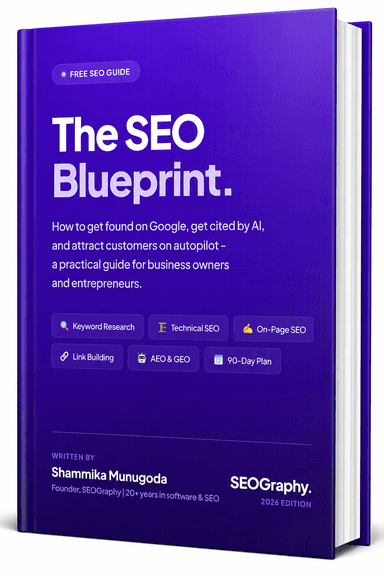
Free eBook

Grab The SEO Blueprint.

How to get found on Google, get cited by AI, and attract customers on autopilot - a practical guide for business owners and entrepreneurs.

  • Keyword research and on-page SEO tactics
  • Technical SEO and link building strategies
  • A 90-day SEO action plan

No spam. Unsubscribe any time. Your email is safe with us.

The SEO Blueprint - free eBook by Shammika Munugoda
Quick quiz · 5 questions

Multi-location & map pack ranking - quick check

5 randomized questions drawn from a pool of 11. Different every time you take it. Takes about two minutes.

Launching 24 August--d --h --m --s

Pricing is already 50% off. Waitlist members get another 10%.

Join the waitlist and we will email you a personal discount code that stacks an extra 10% on top of launch pricing the day SEOGraphy goes live. The free tools stay free either way.

No spam. One launch email, then your code. Unsubscribe anytime.

← PreviousLocalBusiness schema: telling search engines exactly who and where you are
Keep learning

More in Local SEO

How to optimise your Google Business Profile for the map pack

9 min read
→

NAP consistency and local citations: the trust layer under your rankings

8 min read
→

Local keyword research and service-area pages that do not cannibalise

10 min read
→

Skip the writing. Keep the SEO.

SEOGraphy drafts, illustrates, and publishes articles that follow the playbook above - automatically.

Try SEOGraphy free →
SEOGraphySEOGraphy

AI-powered blog writing with auto-generated images and one-click WordPress publishing.

Product

  • How It Works
  • Pricing
  • Roadmap
  • Changelog
  • Join Waitlist

Learn

  • Technical SEO
  • On-Page SEO
  • Off-Page SEO
  • Keyword Research
  • All Guides →

Free SEO Tools

  • HTTP Status Checker
  • Page Title Checker
  • Robots.txt Checker
  • Broken Link Checker
  • All Free Tools →

Free AI Tools

  • Blog Post Generator
  • AI Introduction Writer
  • AI Conclusion Writer
  • FAQ Generator
  • All Free AI Tools →

Company

  • About
  • Blog
  • Help
  • Support
  • Testimonials
PrivacyTermsCookie PolicySecurityStatus

© 2026 SEOGraphy. All rights reserved.

Made in Melbourne 🇦🇺. Built by Apptimistic